


What is a COI? – An Insurance Expert Response


What is a COI (Certificate of Insurance)? Understanding its Meaning and Importance.
A Certificate of Insurance (COI) is a crucial document that outlines a third-party vendor’s insurance coverage. It includes the coverage limits (the maximum dollar amount a policy will pay), the types of incidents covered, and the policy’s effective and expiration dates.
Here we discuss the meaning of a COI, give you an example, talk about what it means reach COI compliance, and show you some ways to streamline your COI compliance process.
What is a COI?
A COI protects both yourself (the company) and your potential third-party vendor from on-the job liabilities. It also ensures financial security and peace of mind, and creates risk management expectations that can help shape strong working relationships.
A compliant COI should be customized to the request. For example, if the third-party vendor is insured up to $5 million in liability limits, but you (the company) are asking for $1 million, the third-party certificate should reflect the $1 million.
A COI acts as a legal document that shows all stakeholders involved that they are properly protected (i.e. compliant) by meeting the company-specified insurance requirements.
It can also indicate that an additional insured has been added, meaning any potential financial losses caused by them will also be taken care of.
Therefore, understanding the meaning of a COI and why it matters can be immensely beneficial for your businesses.
Example COI ACORD Form
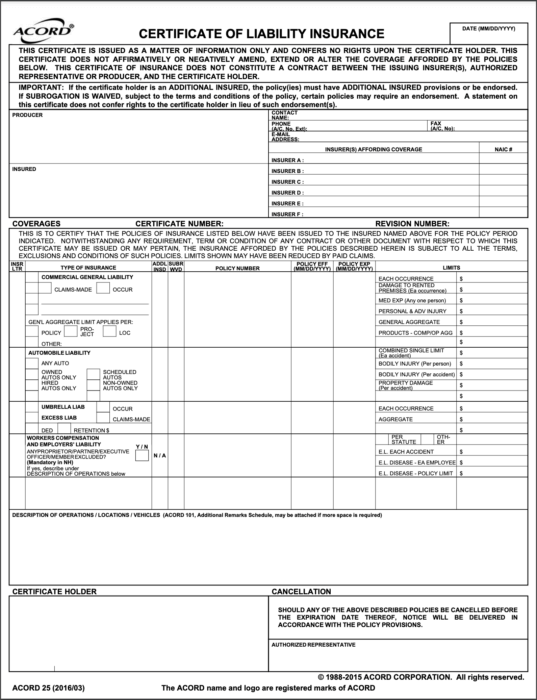
The most widely used COI template is the ACORD form — Called a Certificate of Liability — which was developed to simplify communications across the insurance industry. So, make sure to get your hands on one from all of your vendors!
What does a COI typically include?
A certificate of insurance, or COI, is a document that includes basic information about an insurance policy.
This document typically includes the
- Insured’s mailing address
- Contact information for the insurance company
- Type of policy
- Policy effective dates
- Coverage limits
Additionally, any additional insured parties, such as other people or companies covered by the policy, will be listed on the COI.
A sample COI for small business insurance might include details about general liability, commercial property, commercial auto, and workers’ compensation insurance. All of these insurance types may be necessary for the small business to be fully compliant.
As a certificate holder, your name and contact information will also be included on the COI. If you request a COI from another small business owner, they are required to notify you of any policy cancellations.

See Evident in Action
Transform certificate of insurance (COI) verification with Evident
Request a DemoIdentifying Types of Coverage in a COI
From liability to workers’ compensation, there are numerous types of COIs. This makes it crucial for businesses to maintain a diligent tracking process that assesses document legitimacy, levels of protection, and expiration dates. Just one non-compliant COI can cause millions in losses.
Certificate of Liability Insurance
A Certificate of Liability Insurance (CLI) is an example of a powerful COI document that can save you from financial turmoil.
Rather than providing you with another partial summary of a vendor’s COI compliance, a CLI is a concise summary of all the insurance coverage that they carry in relation to a specific task or project. It assesses their full COI compliance.
The coverage options that a typical sample CLI includes are:
- General liability, which covers damages or injuries caused by you or your employees.
- Auto insurance, which covers accidents that you may cause while driving.
- Workers compensation, which pays for any injuries or illnesses that your employees may sustain while on the job.
- Umbrella or excess coverage provides additional protection beyond what your underlying policies offer.
So next time you’re asked for a CLI, remember that it’s much more than just a piece of paper – it’s a compliance shield that protects you from financial devastation.
How to Get a Certificate of Insurance
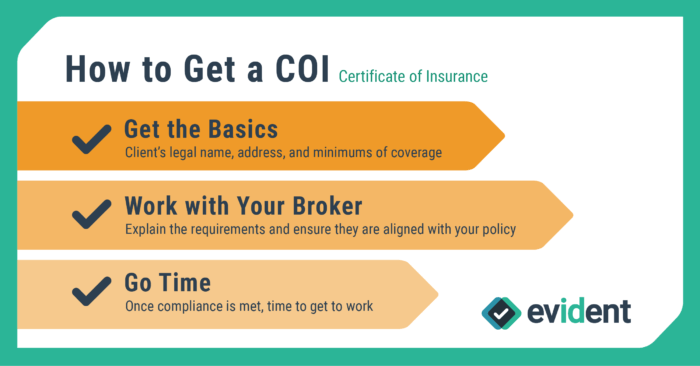
Be sure to share these three steps with your third-party vendor, and help them become compliant by providing a sample COI or CLI, as well as some good examples. Here is the what we suggest you say to your vendors:
- Confirm the basics: Your full legal name, address, and tax identification. These are easy things to get wrong during the COI disclosure process. This is also a good time to make sure you we are all on the same page about the meanings of terms in the COI, and the coverage limits to achieve COI compliance.
- Call your broker: Now that we are on the same page, explain the company requirements to your broker and tell them you need proof of insurance.
- If you already meet the policy requirements, then your broker will simply provide the COI.
- If not, your broker will work with you to update your insurance policy so that you can submit a compliant COI.
- Start work! All requirements are met!? Sign your COI and send it to the hiring company, achieve COI compliance, and get to work!
Although this process seems straightforward, budget for delays. Getting an approved COI can take days or even weeks, depending on the bandwidth of each individual player in this chain.
Common COI Compliance Mistakes
Now that you have supported your third party vendors and are hopefully receiving a steady flow of COI submissions, it’s time to make sure that you are verification process is on point by avoiding common pitfalls.
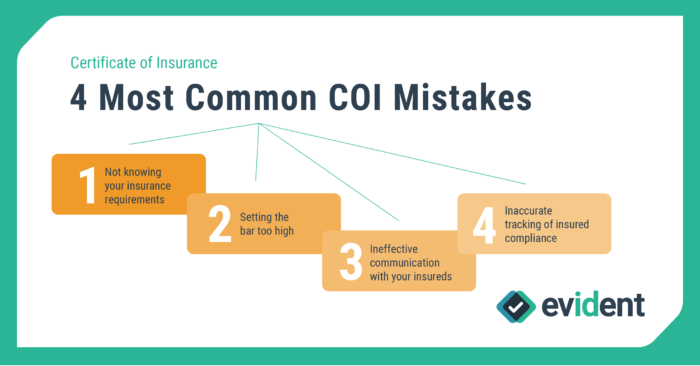
Here are 4 common example COI mistakes:
- Not knowing your own insurance requirements.
- Setting the bar too high.
- Ineffective communication with your third party vendors.
- Inaccurate ongoing tracking of compliance.
Not Knowing Your Own Insurance Requirements
As with any other insurance product, your business insurance is catered to the specific data a vendor provides. When securing business insurance, your vendors also need to comply with the standard expectations set by your industry.
For example, when a construction company seeks insurance, the premiums are based on their specific project types and safety records. Their chosen crane rental vendor must also meet industry coverage limits for the insurer to offer coverage. If the crane vendor lacks proper compliance, the construction company might face denied claims or higher premiums, as the vendor’s standards directly impact the insurer’s risk assessment.
Likewise, it’s not uncommon for retailers who are screening product vendors to ask for a sample COI that offers at least $1 or $2 million in total coverage. But if you only secure a policy that offers $500,000, this will automatically disqualify your business.
Setting the Bar too High
Likewise, for the client requiring a COI, opting for excessive coverage requirements can backfire. While these higher requirements provide better protection for your business, they can also mean that good vendors won’t be eligible to work with you.
An example of excessive COI coverage is exorbitant policy premiums that are unsustainable for overhead expenses.
Ineffective Communication With Your Third Party Vendors
With an average of 23 compliance criteria, it can be challenging to communicate all of the COI requirements or what it means to be COI compliant. E.g. Are you compliant if you meet 16/23 criteria?
If you’re still relying on manual communication methods or disparate and clunky document-uploading services, it’s no wonder you struggle to stay on top of COI compliance. We show you a better way below.
Inaccurate Tracking of Insured Compliance
Having access to a vendor’s COI is only relevant if you’re keeping track of full compliance data, as well as expiration dates. If your system doesn’t automatically flag when a COI offers insufficient coverage or a policy is about to expire, your business is now exposed to liability. Luckily, this is another place where COI management tools can help centralize and automate the process.

What is COI Management?
Simply put, COI management allows businesses to easily vet, track, and update COIs from multiple vendors in one straightforward automated system. This helps you minimize risk while ensuring that all data are stored properly for easy access, and through a process that automatically gets your vendors COI compliant.
Why is COI Tracking Important
If you’ve been relying on manual methods of filing COIs and contacting vendors for updates, it’s time to embrace the digital revolution. Old-school methods can pose serious liabilities when critical information falls through the cracks. Opting to automate can save your business headaches and liabilities.
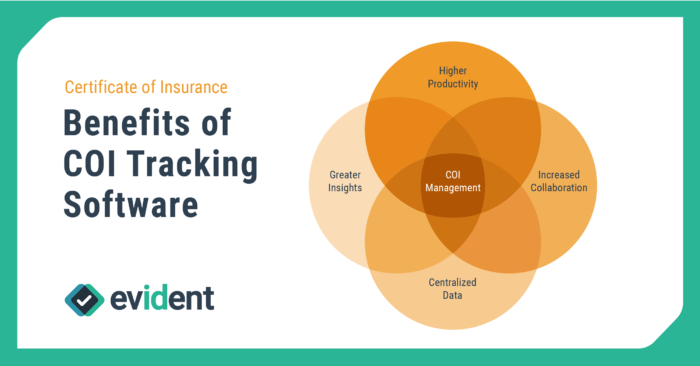
1. Higher Productivity
COI compliance is important, but unless your business is specifically for buying or selling insurance it’s not what’s driving revenue. You need your staff to focus on the tasks that create profit. An automated COI compliance solution gives you peace of mind while also freeing your team to tackle other essential tasks.
2. Increased Collaboration
Sick of trying to explain the meaning or importance of a COI? Are you relying on manual outreach to gather COIs or receiving slow and clunky updates? In some cases, an email might not be on file, or it could be incorrect. Worse still, stilted back-and-forth communications can delay vendor onboarding and SLA projections.
With Evident’s example and pre-programmed follow-up emails, you can ensure both better responses and a better relationship with your vendors.
3. Greater Insights
From seeing a sharp decrease in vendor COI compliance to realizing that perhaps you’re asking for more coverage in certain areas than you need, automation allows you to be more agile. You can mitigate your own risk, while making things as easy as possible for your vendors (who are also NOT insurance experts!).
4. Centralized Data
Distribution is great for retail products and workforces, not so much for information. Disparate systems have always been and will continue to be a recipe for compliance disaster. When all of your data is in one central location, it’s easier to keep track of pending deadlines and vendors that need to submit further verification, and to achieve better insights into potential liability.
Discover the Best COI Tracking Software
Say goodbye to tedious COI tracking spreadsheets and manual tasks. Investing in a platform that streamlines COI management, has hundreds of sample COIs, and ensures coverage across clients and vendors is essential. That’s where Evident comes in. Our cloud-based solution features top-notch COI software and a team of dedicated insurance professionals who understand COI meanings, legal frameworks, contract language, and the myriad other complexities that come with managing COIs.
Our software incorporates automated checks and balances, providing your team with insight into key decision points so that you maximize COI compliance without putting SLAs at risk.
Our easy-to-use technology and unparalleled support make us the best COI tracking and compliance software on the market. However, we encourage you to do your own research to determine the best solution for your needs. Request a free demo to learn more from our experts and get started on your path to compliance today.
Evident’s COI (Certificate of Insurance) Solution

When your system is streamlined, everyone wins — including your vendors. Gone are the days when your compliance team needs to juggle systems to find example COIs or send batch and blast requests for documentation.
When you leverage a COI system that allows you to automate the COI review, approval, and data collection processes, you can maintain easier and more robust relationships with your vendors.
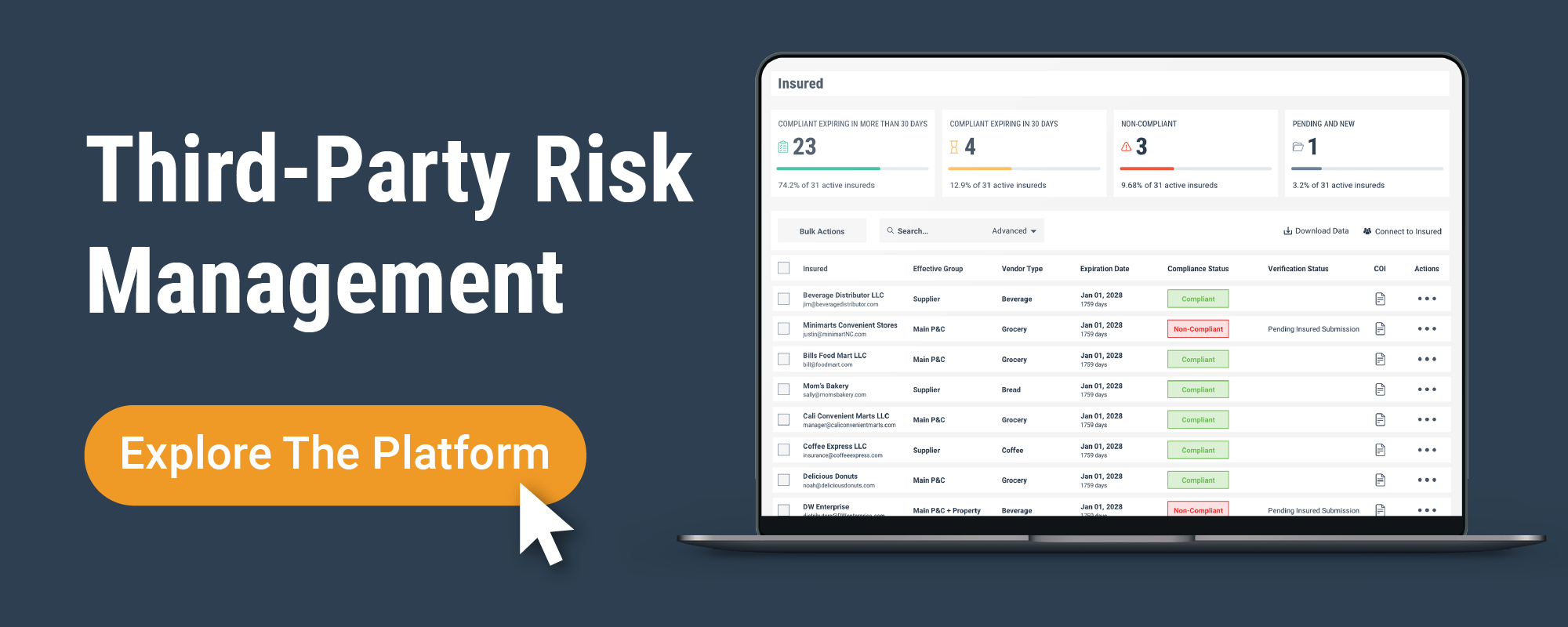
Evident is an automated platform designed to help vendors, insurers, and enterprises coordinate and streamline the insurance verification and compliance process. Take the guesswork out of managing complex vendor relationships.
FAQs
Do I need a COI if using contractors?
Yes, absolutely. Accidents happen with both high-risk (e.g. tradesmen) and low-risk contractors (e.g. accountants, delivery drivers). If your contractors don’t have compliant COIs, then it’s very difficult for you to recoup any losses they cause. After all, that means they often can’t afford to or are unwilling to cover the losses, and your only other recourse is legal action.
How much does a COI cost?
COI coverage costs vary depending on factors like the level of risk and coverage limits. But, the actual COI is free! If you provide your vendors with the meaning of a COI, an example, and some real life sample COIs, then they should have no problem securing their own from their broker at no extra charge.
Related Resources
- January Compliance Coffee Talk: Risk Manager Career Paths
- December Compliance Coffee Talk: Top Questions & Scenarios in 2025
- November Compliance Coffee Talk: Managing the Risks of Special Events
- How To Request a Certificate of Insurance From A Vendor?
- October Compliance Coffee Talk: How to manage vendor pushback on requirements?