

March Compliance Coffee Talk: Building Risk Culture
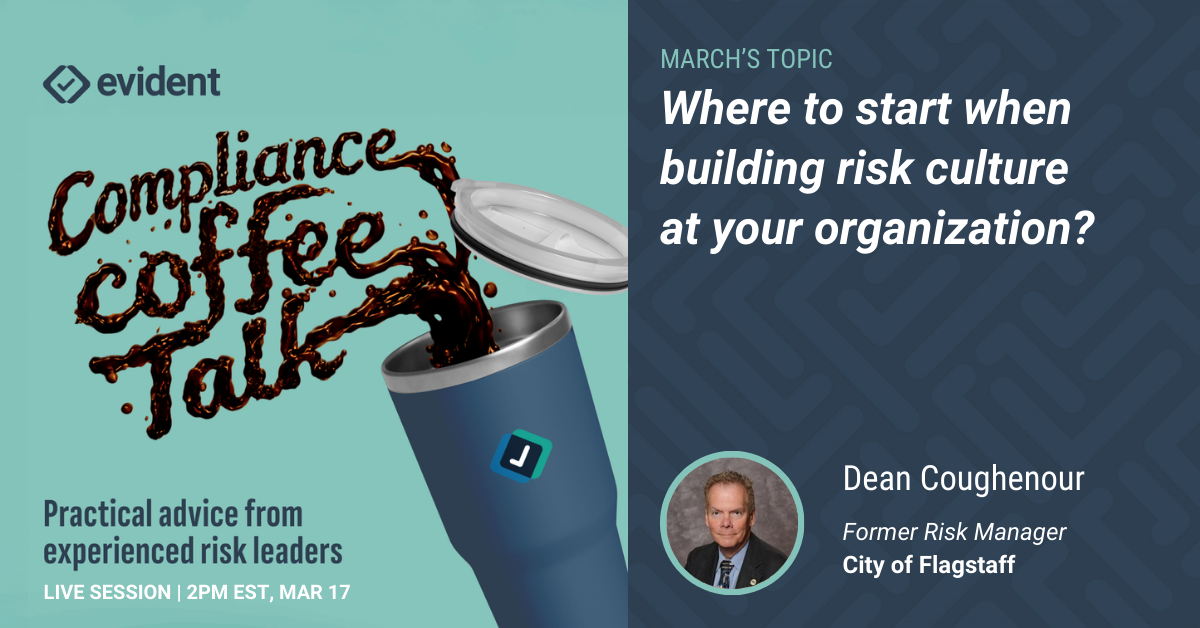
Compliance Coffee Talk covers a new topic each month – RSVP for the series.
March: “Where to start when you’re building risk culture at your organization?”
This topic was prompted by discussions at this quarter’s Georgia PRIMA chapter meeting. One of the speakers, Michelle Jordan from Clayton County Water Authority, talked about her experience moving into risk management after 20 years leading HR, and what it was like building risk culture in her new role. She made a compelling case that risk culture has a huge impact on effectiveness and efficiency, but it takes a long time to build, and the path isn’t always clear. So afterwards at lunch, there was lots of discussion about where to get started, how to find early wins, how to break through organizational resistance, etc.
Dean’s got a ton of experience in this year and many of us have heard him speak on the topic at various conferences, so we thought he’d be a great guest… and we were right!
Watch the full replay, or keep scrolling for a summary of some of the key insights and practical tips from the session.
Meet the Expert
- Dean Coughenour: Former Risk Manager @ City of Flagstaff. Consultant, PRIMA Speakers Bureau
We’ll discuss:
- What are the keys to assessing the current state of your risk program
- How to prioritize between initiatives
- How Dean building relationships with both leaders and the front lines
- Tips for finding quick wins to build momentum
- How Dean evangelizes the ROI of risk management
- Getting to the tipping point with risk culture
Key Takeaways
You’ve gotta listen for the real insights, but if you just want a cheat sheet, here are some of our takeaways from the session.
1. Always explicitly clarify expectations with your supervisor and other leaders *before* you jump into fixing things.
It sounds obvious, but you’ll almost always learn something that surprises you. Knowing expectations is critical. Ask what they think the strengths and weaknesses are. What are the basic expectations, and what does exceeding expectations look like? See if they already have ideas about easy “bang for the buck” improvements.
“Go to your supervisor… and say, what does exceeding expectations look like to you in my position? And then just listen…”
2. You’ve got to get an accurate assessment of how things are today.
That tells you where the burning fires are, where the quick wins might be, and gives you the context for what you need to discuss with colleagues.
It’s a lot of work. Gather 5-year loss runs (WC, GL, Auto, Property) and analyze by department and year. Look for frequent flyer trends.
Review contract language, insurance, permit requirements… then confirm what’s actually happening in practice. There’s usually the disconnect, and sometimes it’s for a good, practical reason. Examples: When he got to Scottsdale, the policy for testing officers after accidents wasn’t reasonable, took officers off the line unnecessarily, so they changed it. And many of the time-intensive reports that the team created weren’t being read because they weren’t actually that useful, so they just stopped creating some of them.
3. Don’t lead with “No”. Start with “Yes, and…” and then explain the context.
Nobody wants to be told No. Oftentimes, with the right context and a little perspective, stakeholders end up answering that question for themselves. This doesn’t mean allowing everything, but it means being open to discussion, and giving people the context they need.
“Yes we could have someone land a prop plane on Main Street for the parade, and here’s what we’d need…” Sometimes that’s all that’s needed to make it clear what the answer should be, but without the resistance and frustration.
“We want to stay away from the word ‘no’. We wanna say ‘yes, but…’ We wanna say ‘yes, and…'”
4. Find quick wins. There are always some high-impact, low-effort items.
Oftentimes that’s subrogation, improvements to default contract language and insurance requirements, something related to permitting.
It’s different at every org. Sometimes something pops up when you just ask your colleagues. Sometimes it’s something small yet critical, like missing endorsements in your insurance requirements, or boilerplate that needs to be added to contracts.
💡Finding champions is critical, and they can come from anywhere in the org at any level. See who naturally has influence, who is trusted, and start there.
5. Ride alongs and walkabouts are critical to do regularly. Weekly hour-long ride alongs are better than a quarterly day-long session.
Be practical, start small, just do it. It doesn’t have to be a huge undertaking, just a regular habit.
“It’s much better to do six 1-hour walkarounds than one it is 8-hours long and less regular. A big part of the value is just being seen regularly.”
6. Building relationships takes time. Make time for it, be patient.
Don’t rush it, and don’t make all of your interactions 100% business. Get to know the people you’re working with.
Different people in different roles and different departments have different motivations. Learn what they are, and then it’ll be easier to relate your work to what matters to them.
7. You have to think of part of your job as like advertising. You’ve got to communicate what’s happening and why it matters.
Tell people about problems avoided, injury rates improved, processes simplified. Just because some of your work might be behind-the-scenes, the impact shouldn’t be.
💡When talking about the ROI of something like savings, use a 5-year multiple, because the reality is that the benefits keep coming. It’s not a $15,000 savings, but rather at 5 x $15,000 = $75,000 over the next 5 years. That’s not being sneaky with math – that’s giving a more accurate view of why it matters.
8. Advice to his younger self: Start slower. Be patient. Slow down and get things right before you speed up.
This answer surprised me! Dean is such a hungry, hard-charging, problem solver. But his answer made sense: You’ve got to take time to figure out what an organization truly needs, both from a risk management operations pov, and from a cultural pov. Build credibility with quick wins while you’re learning what your environment and organization truly needs. Once you’re starting from a point of credibility and clarity, it’ll be easier to go faster later.