


Manual vs. Automated COI Verification: Cost, Risk, and Scalability
Manual vs. Automated COI Verification: Cost, Risk, and Scalability
Automated COI verification is the use of software systems to validate certificates of insurance (COIs), monitor policy compliance, and enforce vendor insurance requirements without manual review. Because every vendor, contractor, and subcontractor introduces potential liability exposure, COI verification helps teams control operational risk. Verifying insurance coverage ensures that risk transfer requirements are consistently enforced before work begins and throughout the vendor lifecycle.
However, organizations that rely on manual COI verification face operational and financial risks. Inconsistent enforcement, missed policy expirations, uninsured vendors, and process bottlenecks grow as you collect more vendors. Automated COI verification becomes necessary to maintain reliable compliance oversight while reducing administrative overhead and exposure to uninsured incidents.
In this blog, we’ll explain the differences between manual and automated COI verification and help you determine when insurance verification automation becomes a necessity.
Key Takeaways
- Automated COI verification replaces manual certificate tracking with software-driven policy validation and compliance monitoring.
- Manual COI tracking risk increases due to missed expirations, inconsistent enforcement, and human review errors.
- Organizations typically adopt COI automation when vendor volume and compliance complexity exceed manual capacity.
- Automated verification reduces administrative overhead while improving compliance enforcement consistency.
- Continuous monitoring ensures vendors remain insured throughout the lifecycle of contracts and projects.
- For procurement and risk teams, COI automation transforms insurance verification from an administrative task into a scalable compliance control.
Why Manual COI Verification Breaks at Scale
Manual COI verification relies on administrative workflows that are difficult to standardize and maintain as vendor volume increases. A certificate of insurance is usually managed through spreadsheets, email requests, shared drives, and manual document uploads. This creates a lot of friction for collecting and reviewing insurance documentation at several points in the verification process, including:
- Approval queues
- Delayed vendor onboarding
- Inconsistent policy validation
As a result, teams often have limited visibility into real-time vendor compliance status, making it difficult to track which vendors have valid coverage, missing endorsements, or expiring policies.
Over time, manual COI tracking makes teams more reactive. Risk and procurement staff spend most of their time managing documents and follow-ups, leaving little capacity to monitor compliance gaps or address risk exposure.
Risk Exposure: Hidden Costs of Manual COI Verification
Manual COI tracking introduces operational gaps that can expose organizations to significant financial and legal risk. Examples of manual COI risk exposure include:
- Missed insurance expiration dates
- Vendors operating with lapsed or insufficient insurance coverage
- Missing endorsements or incorrect policy limits
- Inconsistent enforcement of insurance requirements
- Unverified subcontractors entering projects without validated insurance documentation
- Delayed vendor onboarding
Small administrative gaps in the COI management process can lead to large financial liabilities if uninsured vendors cause workplace incidents, property damage, or third-party injuries.
What Is the Difference Between Manual and Automated COI Verification?
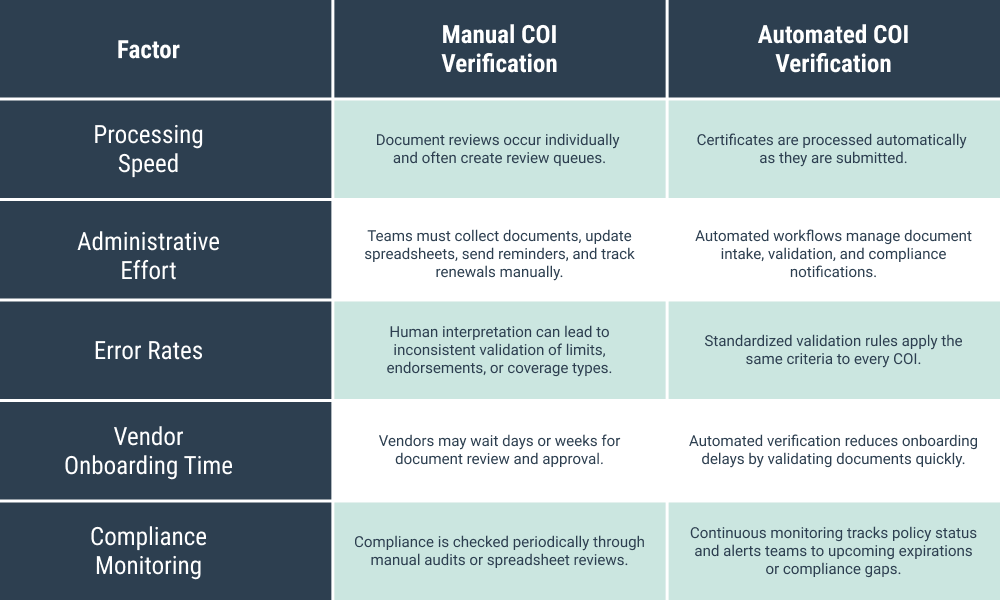
Manual COI verification is a human-driven process where insurance, review policy details, and COIs are tracked through spreadsheets, emails, document portals, etc. Automated COI verification, on the other hand, uses software to collect insurance documents, validate policy requirements, and continuously monitor vendor credentials using streamlined rules and workflows.
In practice, automation replaces the most time-consuming steps in manual verification while standardizing how insurance requirements are enforced. The result is faster verification cycles, lower administrative burden, and more consistent compliance oversight.
Key Differences
What Are the Risks of Manual COI Tracking?
Manual COI tracking increases compliance risk, operational inefficiency, and liability exposure because it depends on human oversight to review and monitor insurance documentation.
Procurement and risk teams must manually interpret policy limits, endorsements, and expiration dates across hundreds or thousands of vendor certificates. This introduces variability in how insurance requirements are applied and enforced.
When verification processes rely on spreadsheets and periodic reviews, compliance gaps can remain undetected until a policy lapse, incident, or audit exposes them.
Primary risks of the manual COI management process:
- Missed policy expirations
- Uninsured vendors performing work without meeting contractual insurance requirements
- Incomplete policy documentation
- Difficulty detecting coverage gaps as they occur
- Delayed risk detection
- Regulatory exposure
- Financial liability
- Vendor delays
- Audit complexity
When Should a Company Switch to Automated COI Verification?
Organizations typically switch to automated COI verification when manual processes can no longer reliably enforce insurance requirements. As vendor volume increases, the number of certificates of insurance, policy renewals, endorsements, and compliance checks expands too.
At that point, manual tracking systems struggle to maintain consistent enforcement. Insurance verification automation becomes necessary to ensure that insurance requirements are verified quickly, applied consistently, and monitored continuously.
Common Triggers for Adopting Automated COI Verification
Organizations often reach an operational tipping point when:
- Vendor networks exceed 100–200 active vendors
- Compliance or procurement teams spend multiple hours per week in the manual COI management process
- Insurance renewal cycles occur frequently
- Projects involve strict enforcement of policy limits, endorsements, and coverage requirements
Several operational signals indicate that manual COI checks are no longer sustainable:
- Increasing review backlogs
- Compliance gaps discovered during audits
- Vendor onboarding delays
How Much Does Automated COI Verification Cost?
Automated COI verification costs vary based on many factors. Most platforms price their services according to the number of vendors being monitored and the level of insurance verification required. Organizations with large vendor ecosystems, complex insurance requirements, or integrations with procurement and vendor management systems may require more advanced capabilities, which can influence overall pricing.
Several variables influence the cost of an automated COI verification platform:
- Vendor Volume: The number of vendors, contractors, and subcontractors whose insurance documentation must be verified and monitored.
- Level of Policy Validation: Whether the system validates basic coverage details or performs deeper checks on limits, endorsements, and exclusions.
- Integration With Procurement or Vendor Management Systems: Connecting verification workflows to existing platforms such as ERP, vendor portals, or contract management systems.
- Compliance Monitoring Capabilities: Continuous monitoring of insurance expiration dates, policy updates, and compliance status.
- Vendor Onboarding Automation: Automated workflows that collect COIs, request renewals, and manage vendor communications.
Can Automated COI Verification Reduce Compliance Risk?
Yes. Automated COI verification reduces compliance risk by applying consistent policy validation rules and continuous insurance monitoring across every vendor relationship. Automated systems validate insurance coverage against predefined requirements and track policy status in real time. This ensures vendors maintain required coverage throughout the contract lifecycle.
Is Automated Insurance Verification More Accurate Than Manual Review?
Yes. Insurance verification automation is typically more accurate than manual review because it applies standardized validation rules consistently across every COI. Manual verification relies on individual reviewers interpreting policy limits, endorsements, and coverage requirements, which can lead to inconsistent enforcement across vendors or departments. Automated systems evaluate each COI against predefined insurance requirements, making sure every document is validated using the same criteria.
Scale COI Compliance With Evident
Manual COI verification becomes difficult to sustain as vendor networks grow. Automated COI verification replaces fragmented processes with standardized validation, continuous monitoring, and centralized compliance records, allowing organizations to scale compliance oversight while reducing operational risk.
Platforms like Evident go beyond simple COI tracking. Evident automates the collection, verification, and monitoring of vendor documentation while helping teams identify compliance gaps, eliminate verification bottlenecks, and enforce insurance requirements consistently. With configurable workflows, continuous monitoring, and a network of over 4 million verified third parties, Evident enables procurement and risk teams to manage vendor compliance at scale, without increasing administrative burden.
To learn more, request a demo or read through some of our helpful resources.
Related Resources
- What Insurance Should You Require from Vendors? A Practical Checklist
- Waiver of Subrogation: What It Means and Why It Matters
- Workers’ Compensation Monopolistic States: What They Are and How to Verify COIs
- Understanding Subcontractor Insurance – What You Need to Know
- What Risk Managers Should Know About Working with Police