


Tips and Best Practices to Engage Your Insureds

Branding and Contextual Relevance
Your emails need to be engaging. Insureds are more likely to respond to COI requests that appear to have been sent directly from your business, so it’s crucial that your branding is recognizable to your Insureds, especially if your company has multiple logos and/or brand colors, or if you’re using a DBA instead of a legal business name.
You should also consider the modality in which your Insureds will read the request notifications. For example, will they be in the field and read them on a mobile device, or will they read them from their office computer? Responsive emails are key, as these notifications will likely be opened on both desktop and mobile devices, and poor email formatting doesn’t render well on different devices. With our email templates, you can customize your emails without concern for these types of formatting issues.
Clarity
Also key to better engagement is avoiding ambiguity and embracing excessive clarity around both your insurance requirements and the insurance verification process, itself. This can be accomplished by sharing links to a detailed list of insurance requirements and sample COIs to help demonstrate your business’ specific insurance coverage needs.
It’s important to create one or more sample COIs, depending on the number of Insured groups that you have. For example, if all of your Insureds have identical sets of coverage requirements, then one sample COI would suffice. If your Insureds are categorized into distinct subgroups, each with differing requirements, then a unique sample COI should be created to represent each of these sets of needs. It’s critical to ensure that your sample COI(s) accurately reflect what is needed from your Insureds because the Insured will send the sample COI to their Agent/Broker to help them understand what needs to be reflected on the COI.
It’s also essential that you provide your support contact information so that your Insureds can easily get in contact with you if they have questions regarding the insurance requirements, their compliance status, or the insurance verification process overall. Support contact information helps your Insureds avoid confusion and dead-ends.
When an Insured reads your request for COI submission, they should clearly understand what is needed from them, how to get help when questions arise, and how to close any gaps in insurance coverage they may have. For the latter, non-compliant notifications sent from our service contain explicit details about coverage gaps after submission so that the Insured knows exactly what needs to be rectified to get to a compliant state.
It also needs to be clear to the Insured how to request an exception to a requirement. You will likely have cases where an Insured doesn’t have one or more of the requested coverages because the value of their involvement with you doesn’t match the cost of obtaining the coverage.
Let’s say you’re a national waste hauling service provider and you have an Insured who hauls waste in a remote area or one who consistently totes fewer loads than your average hauler. In this scenario, the Insured might not feel like the cost to obtain certain coverage requirements is worthwhile for them, and they need to know how to effectively and efficiently communicate this back to you.
Automation, Notifications, and Reminders
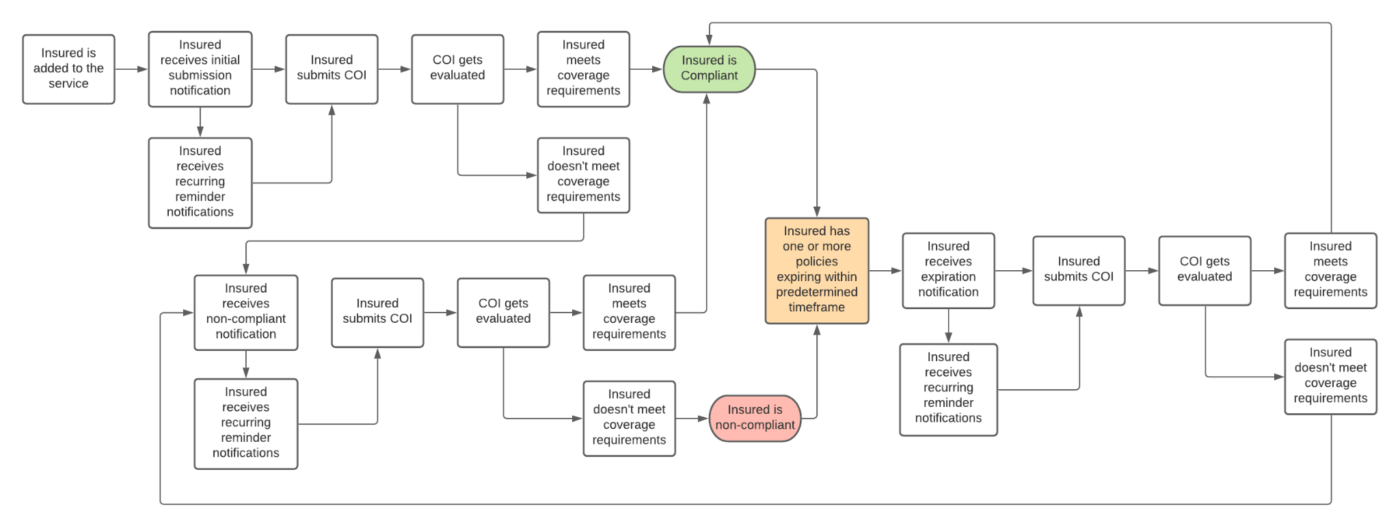
Automation is at the core of Evident’s Insurance Verification solution, allowing you to “set and forget,” thereby reducing administrative overhead and burden. We do this in a number of ways, one of which is by providing three types of automated engagement with Insureds: new, non-compliant, and expiring. Having automated notifications that are specific to what is being requested from the Insured helps to keep engagement high, and engaged Insureds are more likely to respond faster to COI submission requests, ultimately leading to better results.
Notification reminders are also automated, and reminder cadences provide substantial value. They minimize touches with the Insured, offer the easiest and simplest path for Insureds to comply, and help to remove objections and roadblocks.
Overly aggressive reminders and incessant non-compliance notifications are unlikely to improve results, as your Insureds will likely become irritated by them, especially if these never-ending notices aren’t properly pathing them toward successful submission. One of the most powerful capabilities that Evident’s Insurance Verification solution offers is the ability to establish a reminder cadence that is suitable for your population of Insureds.
Our philosophy regarding reminders is that they should be targeted and only sent when needed (and executed automatically), be persistent (but not annoying), mirror best-of-breed marketing platforms by enabling a drip campaign, and stop once the Insured responds. To help achieve this, we utilize two different types of cadences: a standard, normal cadence with a decreasing frequency of reminders, and a reverse cadence, reserved for expiration requests, which starts out with sparse notifications, and slowly increases the frequency of reminders as the expiration date nears in order to convey a sense of increasing urgency.
Default Settings
Evident has fine-tuned communications settings to optimize the outcomes as a result of learnings from hundreds of thousands of engagements. Some of the default settings we provide include: reminder cadences, quick help text, non-compliance text, and email template configuration.
Evaluation
The analytics and reporting capabilities that our Insurance Verification solution offers gives you the ability to measure the success of your Insured engagement so that you can learn and make adjustments, if needed, and have peace of mind knowing that nearly 25% of COI requests that commonly go unanswered won’t be a concern for your business, since you have Evident and our engagement philosophy working on your behalf.
Insured Engagement Overview and Best Practices
The data from Evident’s latest research report, The State of Third-Party Insurance Verification, revealed that engaging with Insureds was a substantial challenge for businesses. In fact, nearly a quarter of requests for proof of insurance went unanswered. Among the factors contributing to this problem were unclear communication of requirements, insufficient processes for supporting and managing relationships, and an overall lack of adherence to outreach best practices.
This flowchart outlines an optimal third-party insurance verification process:
Why Engagement Matters
Engagement is critical for an insurance verification program to be successful. The first hurdle is getting your Insureds to respond to a COI request. For the Insured to respond, they must receive something to view, read, and take the requested action (upload a COI). Beyond merely sending email communication, interaction is also expected, so you’ll need to properly set up the process to support the bidirectional nature of engagement.
Response rates are only one piece of the puzzle, however. Consider a scenario where your entire Insured population responds to your request, yet none of them provide sufficient documentation. Would this accomplishment be considered adequate? Ultimately, in addition to achieving high response rates, engagement with your Insureds should also be geared toward ensuring successful conversion.
There are many ways to demonstrate proof of insurance coverage, and not all COIs are the same. COIs are created to reflect the specific Coverage Types and Coverage Fields of interest for the certificate holder. As such, several drastically different COIs can be generated for the same coverage, each dependent on what the certificate holder is requesting to see—because of this, being mindful of how you relay the information needed from your Insureds is a critical component of the engagement process.
Effective engagement is also crucial for your population of Insureds, as insurance verification processes can become cumbersome for them without proper due diligence. Clarity is the hallmark of a positive Insured experience, and achievement of both is measured by initial success. Without sufficiently clear and
Related Resources
- What Insurance Should You Require from Vendors? A Practical Checklist
- Waiver of Subrogation: What It Means and Why It Matters
- Workers’ Compensation Monopolistic States: What They Are and How to Verify COIs
- Understanding Subcontractor Insurance – What You Need to Know
- What Risk Managers Should Know About Working with Police