


Onboarding Contractors in Your System: Elevating Your TPRM Strategy

Onboarding contractors is a critical step in managing third-party relationships, but it’s often fraught with inefficiencies and risks. Occupational injuries are common — over 374 million people worldwide are involved in workplace accidents each year. If you hire a contractor without valid insurance coverage, you might bear the financial and legal burden when a contractor’s employee gets injured while working on your property.
A streamlined contractor onboarding process not only accelerates project timelines but also strengthens your overall Third-Party Risk Management strategy. By focusing on key elements like compliance verification, risk assessments, and automation, organizations can create a more secure and effective framework for integrating contractors into their operations.
This blog explores how modern approaches to onboarding can elevate your TPRM strategy, ensuring your contractors are ready to perform while protecting your business from potential risks.
Understanding the Importance of Customized Onboarding Process
When working with different types of contractors, each may have to comply with unique regulations, meet particular financial requirements, or adhere to a specific third-party code of conduct set by your company.
With a software tool that allows you to customize onboarding, you can create, adjust, and configure contractor profiles. You can tailor evaluations to match your unique risk management criteria. This ensures the entire process aligns with your existing contractor requirements and onboarding workflows.
Key Challenges in Contractor Onboarding
When done right, onboarding makes teaming up with suitable contractors easy. However, businesses often face the following problems in the process:
Lack of Standardization in Processes
Onboarding third parties might involve several departments, including your procurement, finance, and operations teams. Without uniform standard procedures across the entire firm and centralized in a single platform, each department might create its onboarding processes. That’s bad news because:
- Key steps can easily be missed: For instance, forgetting to collect a critical contractor document like a certificate of insurance (COI) can lead to claim losses if accidents or injuries occur.
- Duplicate efforts might pile up: For example, one team might ask for documents that another has already collected. As a result, you waste time and cause delays that may frustrate contractors.
Time-Consuming Documentation and Verification
A major part of contractor onboarding is conducting a comprehensive risk assessment. The goal is to obtain and verify documents, such as:
- COIs
- Financial statements
- Business registration documents
- Tax documents
- Contractor licenses
Manually collecting, reviewing, and managing all of this consumes a lot of time, especially if you’re dealing with multiple contractors. Besides being slow, manual documentation and verification are prone to human error.
Ensuring Compliance With Company Policies and Regulatory Requirements
Compliance can be tricky. Contractors often need to follow local, state, and federal regulations. In California, for example, all contractors must be licensed by the Contractors State License Board. They should also have general liability insurance. Working with a contractor that doesn’t meet these requirements can lead to fines, lawsuits, or reputation damage for your organization.
In addition to external regulations, you must make sure contractors meet your organization’s code of conduct and ethical standards. The compliance burden is even heavier if you’re managing multiple third parties.
How do you overcome all these challenges when onboarding contractors in your system?
Best Practices for Effortless Contractor Onboarding
Integrating third parties into your organization can be tiresome and time-consuming. But with a few best practices, the process becomes efficient. Here’s what you can do to streamline contractor onboarding:
Customize Your Workflow
Create an onboarding workflow that outlines the stages a new contractor goes through before starting a project or performing a specific task. The stages should be sequential and repeatable to provide a standardized procedure. This minimizes missed steps and duplicated efforts since the onboarding process for a particular type of contractor becomes uniform across the entire organization.
Different contractors may need to meet distinct standards or regulatory requirements. Make sure you customize your onboarding workflows to the evaluation requirements of each contractor type.
Centralize Documentation
Managing a large volume of documents from multiple contractors is difficult if the files are scattered across different systems in your organization.
Having all of them in one place makes it easy to keep things organized. It speeds up onboarding because you won’t jump from one system to another or scroll through endless email threads looking for files. You spend less time scrambling for contractor information and focus more on getting them ready to work.
Evident’s Third-Party Risk Management Solution provides a unified platform for storing all contractor documents. This includes, but is not limited to, contracts, proof of insurance, tax forms, compliance certifications, and financial documents. Keeping files in a single place unlocks multiple benefits, including:
- Improving information accessibility and simplifying collaboration for teams handling the onboarding process.
- Making it easy to track which documents have been submitted, reviewed, or approved to promote compliance.
- Preventing duplicate onboarding efforts by ensuring everyone is on the same page.
Automate Document Collection and Streamline Contractor Verification
Contractor onboarding involves repetitive tasks. When done manually, these processes are time-consuming, cumbersome, and error-prone.
The good news? Powerful contractor management technology like Evident makes everything easy. Third parties can seamlessly submit necessary paperwork through a portal in the platform, which fully automates document collection. Once the files are uploaded into the software, you don’t have to review them. The tool has robust machine learning algorithms that can accurately assess documents to reveal whether a contractor is (among many other things):
- Financially stable
- Compliant with applicable regulation
- Properly insured
The automated system speeds up the verification process, delivering results in minutes or hours instead of days. The time you would otherwise spend on manual evaluation can be used to help contractors get started quickly in their roles.
You should validate whether they are legitimate entities and evaluate their partnering risks. A contractor management solution like Evident has robust features that streamline the following verification and risk management processes:
- Business entity validation: Verify a business’s registration status, confirm its official addresses, and validate that individual contacts are genuine company representatives. This provides confidence that you’ve teamed up with a credible contractor and are working with the appropriate representative in their company.
- Online presence evaluation: Evaluate a contractor’s credibility and brand reputation by assessing their online presence. For example, you can use the tool to check whether a third party you want to work with has an official website or has implemented solid online cybersecurity measures.
- Business risk monitoring: Identify the potential threats of working with an organization by checking for sanctions, regulatory issues, compliance risks, legal actions, and more. In return, you avoid partnerships that are too risky.
Establish Clear Communication Channels and Provide Support
When contractors partner with your organization for the first time, they come in as outsiders unfamiliar with your systems, policies, and expectations. Effective communication keeps everyone informed and on the same page.
Before starting work, tell contractors how you will reach out to them throughout the project, how often, and what tools you’ll use. For instance, you might set up regular check-ins through email. Meanwhile, you can deliver daily, real-time updates via the chat function in collaboration tools.
Make sure contractors know who to contact when they need clarification. A single point of contact, such as a project or procurement manager ensures contractors know what to do when a problem emerges.
Besides establishing clear communication channels, provide contractors with access to everything they need to do their jobs superbly. This could encompass onboarding resources that bring them up to speed with their responsibilities and the organization’s expectations.

Technology’s Role in Enhancing the Onboarding Experience
Contractor management solutions can automate manual onboarding tasks and allow you to tailor operations to your organization’s needs. For this reason, the tools speed up onboarding and make tech-enabled contractor evaluation more thorough than manual assessments.
But how exactly do the solutions enable you to customize and automate onboarding processes? A technology like Evident’s Third-Party Risk Management Platform allows you to create contractor profiles and customize them based on type and project. You can tailor evaluation criteria to a contractor’s unique compliance requirements and project standards.
The solution automates manual onboarding processes like gathering documents, collecting e-signatures, and checking compliance. The system can quickly assess regulatory compliance and verify a contractor’s W9 forms, licenses, and insurance. The time you would have spent on these administrative tasks could go to more important activities, such as helping contractors launch a project as soon as possible.
In addition to saving time, robust technology can make it easy to find and connect with contractors who meet your requirements. For example, The Evident Network gives you access to over four million pre-vetted third parties.
With contractors who are already verified, you can skip the tedious back-and-forth of collecting documents and double-checking details. Focus on choosing the right partners for your project instead of worrying about whether they meet your standards with pre-vetting that quickens onboarding.
Onboarding Contractors in Your System Made Easy With Evident
Evident streamlines contractor onboarding in multiple ways:
- Centralizes the onboarding process
- Allows creating contractor profiles and customizing them to your organization’s unique requirements
- Enables collection of e-signatures to ensure secure contract execution
- Verifies contractor’s business details to validate third-party legitimacy
- Automates compliance checks by evaluating contractor documents using artificial intelligence
- Verifies insurance status of third parties
The automation platform minimizes manual effort and errors, which speeds up onboarding and makes compliance assessments more accurate.
We understand that the need to ensure third parties comply with standards and regulations doesn’t stop once the onboarding process is complete. It’s an ongoing commitment to mitigate reputational, regulatory, and financial risks, among many others.
That’s why our platform allows you to continuously monitor contractors’ key risk signals, such as bankruptcies, changes in insurance coverage, and court judgments. This allows proactive risk management.
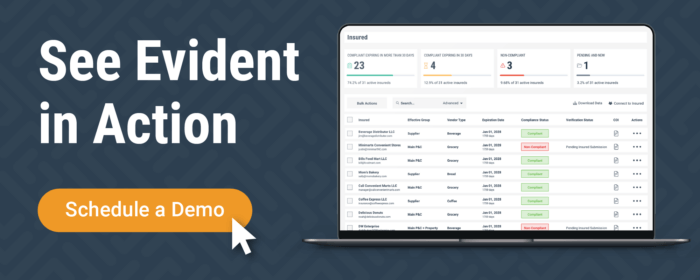
Request a demo today to see how Evident transforms contractor onboarding and third-party risk management.
Related Resources
- What Insurance Should You Require from Vendors? A Practical Checklist
- Waiver of Subrogation: What It Means and Why It Matters
- Workers’ Compensation Monopolistic States: What They Are and How to Verify COIs
- Understanding Subcontractor Insurance – What You Need to Know
- Loss Payee vs. Additional Insured: Definition, Benefits, and Examples