
Workshop · March 2026
Risk Management Essentials Workshop: Limitation of Liability
Noelle McCall has spent more than 25 years reviewing contracts for clients. Here is how she reads LOL clauses, five negotiating strategies ranked by how much protection they keep, and the carve-outs that protect your insurance recovery.
Guest expert
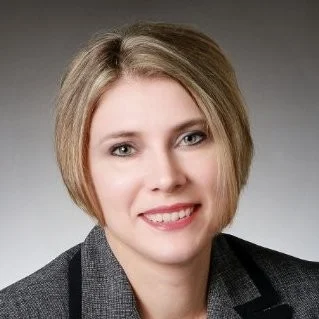
Noelle McCall
National Practice Leader for Contract Review, Howden
Almost 30 years in the insurance industry
- 25+ years of contract review consulting
- Former National Practice Leader for Contract Review at Marsh and Aon
- Speaker for The Institutes, RIMS and Lawline
- CIC, CRM, CCIP, CRP, ACRA, CISR
The session
Negotiating limitation of liability clauses as a public entity
Noelle McCall is National Practice Leader for Contract Review at Howden, a role she previously held at Marsh and Aon. She has almost 30 years in the insurance industry and more than 25 years of contract review consulting, and she has reviewed thousands of contracts across industries.
Noelle joined us to lead our Risk Management Essentials workshop on limitation of liability. The recording is from her January 2026 session. She presented from an insurance and risk perspective, not a legal one, so review any contract wording with your legal counsel.
Watch the session, open the slides and Noelle's sample negotiation playbook, or read the takeaways below.
Key takeaways
13 takeaways from the session
Noelle's advice in four themes, from how LOL clauses work to keeping your insurance recovery intact.
01–04
Know what an LOL clause does
A limitation of liability caps what the other party owes you, and it reaches further into the contract than many people expect.
- 01
An LOL caps what the other side owes you
A limitation of liability clause restricts how much one party has to pay the other for losses, damage or injuries caused by a breach. Noelle sees vendors add them most often in technology, cyber, product and professional services contracts.
The takeaway: Look for an LOL clause in every vendor contract, and read it before you sign.
- 02
Know the three common types
An LOL can cap damages at a fixed amount or a multiple of fees, such as one or two times the annual contract value. It can set a time limit, such as requiring claims within 12 months of a loss. Or it can waive consequential damages, so neither side pays the other's indirect losses.
The takeaway: Identify which type, or types, you are looking at before you negotiate.
- 03
Indirect damages are where the bigger risk sits
Direct damages are the cost of fixing the problem: correcting work, hiring a replacement contractor, or paying extra wages during a delay. Indirect damages include lost profits, lost customers, fines, lost rental income and reputational damage, and Noelle says they typically carry the higher risk.
The takeaway: Before you waive consequential damages, list the indirect losses your agency could actually suffer.
- 04
Some liability can't be limited
An LOL generally can't limit liability for bodily injury or property damage to third parties such as the general public, for gross negligence or intentional misconduct, or in ways that violate public policy. The rules vary by state.
The takeaway: Check your state's rules, and expect carve-outs for willful misconduct, gross negligence, IP infringement, data breaches and indemnity.
05–08
Draft and negotiate with context
Noelle tailors every clause to the contract, the vendor and the relationship.
- 05
Don't copy and paste LOL language
Copying an LOL from one contract into the next is common, and Noelle advises against it. Weigh the level of risk, your risk appetite, and the vendor's size: push for a higher cap with a large vendor, while a smaller vendor may need a lower cap with carve-outs for insurance and indemnity.
The takeaway: Tailor each LOL to the contract and the vendor in front of you.
- 06
Keep the LOL in step with indemnity
If the negotiated cap conflicts with the indemnity terms, the contract can become ambiguous, unfair, or riskier than either side expected. The wording should be clear and unambiguous, and depending on the law it may need its own section or bold formatting.
The takeaway: Draft the LOL with the indemnity clause open beside it.
- 07
Start with your template and talk early
Your own contract template is usually written in your favor, so start there and leave the vendor's LOL out. Require vendors to submit any exceptions to your template with their bids, and meet early to explain why a public entity can't agree to certain terms.
The takeaway: Set expectations before bids come in, not right before work starts.
- 08
Keep bids comparable
When one bidder adds an LOL cap and the others don't, the bids are no longer apples to apples. Noelle would tell the bidders adding caps that it weakens their bid and ask them to reconsider.
The takeaway: Use competing bids without caps as leverage.
“These clauses are not one size fits all. The LOL clause should be tailored to each contract, so don't just copy paste.”
Noelle McCallNational Practice Leader for Contract Review, Howden09–11
Five strategies, most to least protective
Noelle ranked five approaches by how much protection the public agency keeps.
- 09
Most protective: no LOL in the vendor's favor
Refusing a vendor-favored cap keeps the vendor fully responsible for the damages it causes. Noelle recommends it for high-risk, high-value contracts, and it promotes accountability.
The takeaway: Hold the line on no cap for your highest-risk contracts.
- 10
Middle ground: a mutual waiver or carve-outs
A mutual waiver of consequential damages keeps each side responsible for direct damages, and vendors often accept it more readily than no LOL at all. If a cap is unavoidable, carve out indemnity and insurance, either all available limits or the limits the contract requires. The second option often suits smaller vendors.
The takeaway: Offer a mutual waiver or a capped LOL with carve-outs before you accept a plain cap.
- 11
Least protective: a cap equal to insurance limits
Matching the cap to the vendor's insurance limits suits larger vendors and simplifies negotiation. You still need to confirm the vendor actually carries those limits and that the coverage fits the work.
The takeaway: If the cap follows insurance, verify the insurance.
“Some of the smallest dollar value contracts can lead to some of the biggest losses.”
Noelle McCallNational Practice Leader for Contract Review, Howden12–13
Protect your insurance recovery
The most common mistake Noelle sees is a cap with no carve-out for insurance.
- 12
A cap can shrink the insurance you required
If you require $10 million in umbrella limits but the LOL caps liability at $1 million with no insurance carve-out, you may only recover $1 million. A consequential damages waiver with no insurance exception can also remove coverage the vendor's policy would have provided for indirect losses.
The takeaway: Carve insurance and indemnity out of every LOL cap.
- 13
Use MICE when a vendor won't drop the LOL
Make the clause mutual. Apply the cap to individual claims rather than the aggregate. Extend the cap's scope or remove its time limit; the practice clause capped liability at fees paid in the three months before a claim. Exclude indemnity, insurance and other key obligations from the cap.
The takeaway: Work through mutual, individual, cap and exclude to move a vendor clause toward balance.
Session slides
View Noelle's slides
The 35-slide deck covers LOL definitions and types, direct and indirect damages, five negotiating strategies, the MICE technique, and sample vendor, balanced and public entity clauses. Noelle's two-page sample negotiation playbook is also available.

Slide 1 · Limitation of liability (opens the slides in a new tab) 
Slide 14 · Common LOL types (opens the slides in a new tab) 
Slide 16 · Direct vs. indirect damages (opens the slides in a new tab) 
Slide 25 · Strategy 3 carve-outs (opens the slides in a new tab) 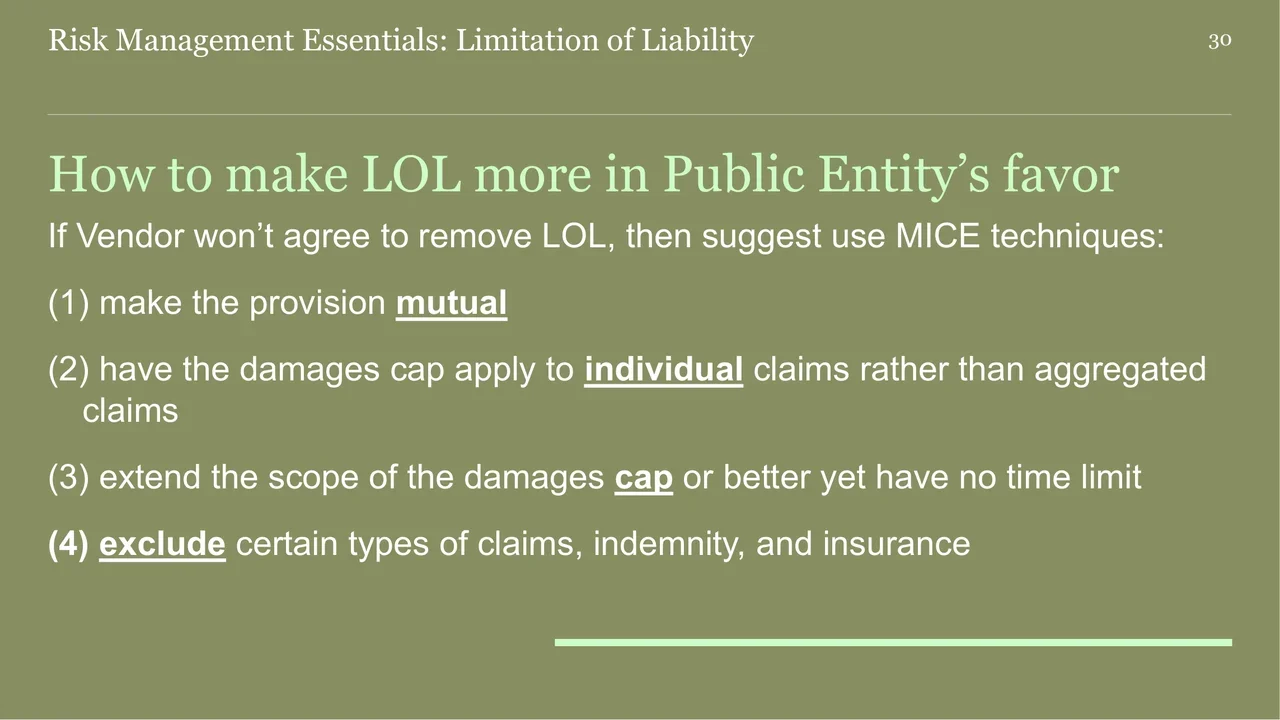
Slide 30 · The MICE technique (opens the slides in a new tab) 
Slide 31 · Sample balanced LOL (opens the slides in a new tab)
Join the next session
Bring your questions to the next workshop
Evident's workshop program brings experienced risk leaders together with public sector and enterprise risk teams, from 30-minute Coffee Talks to longer deep dives.